Dear Reader,
I’m a bit of a health and fitness geek.
I work out every day. I track what I eat.
I get blood work done regularly.
I’ve even experimented with peptides.
And lately, I’ve been trying to find a good health tracker that I don’t hate wearing – which has been surprisingly difficult.
I don’t like wearing an Apple Watch, because I like mechanical watches.
So I tried the Oura Ring.
It was expensive, uncomfortable, and I didn’t like that you had to keep paying a monthly membership for the full features.
Then I tried the Whoop band.
I returned it almost immediately.
It was too big, too bulky, and I didn’t like the strap.
Plus, you can’t even buy the device outright – they force you into an expensive annual subscription.
So when Google came out with its new Fitbit tracker, I bought one immediately.
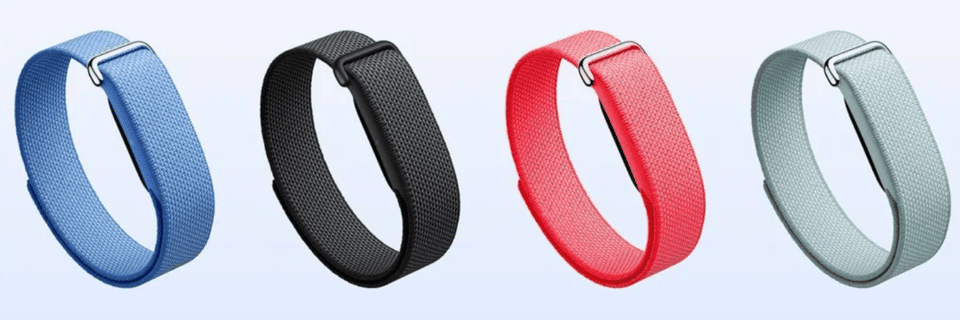
I haven’t even gotten it in the mail yet.
But I’m genuinely excited to try it.
It’s smaller, lighter, and cheaper (about $100, compared to at least $350 for the Oura ring and at least $200/year for the Whoop).
It tracks sleep, resting heart rate, heart rate variability, blood oxygen, and the basic health metrics I care about.
In other words, it does most of what I want a health tracker to do…
For a fraction of what the other companies charge.
And whether I end up loving it or returning it, the whole thing reminded me of one thing:
This is Precisely Why I Love Capitalism
Economic illiterates love to criticize capitalism as a system where profit comes before everything else.
But in capitalism, no company is ever guaranteed a profit.
Capitalism is unending competition…
A constant fight to earn the customer’s money.
The wearables space is a great example.
Whoop and Oura found a profitable niche.
They built good products and charged high prices.
Then Google came in, looked at that same market and said, essentially:
“We can make something smaller, simpler, and cheaper.”
Sure, maybe Google will make less money per device.
But they may make up for it in volume – and thus market share.
Regardless, I don’t really care what Google’s internal strategy is.
As the customer, I care about what I get.
And now I have another option.
A cheaper option. A more minimalist option.
An option that might fit what I want better than the expensive products that came before it.
That is the Beauty of Free Market Competition
The producer wants profit.
But the producer cannot just demand profit.
It has to earn it.
If Whoop wants to keep customers, it may have to switch up the model.
If Oura wants to keep customers, it may have to improve the product.
If Google wants to win market share, it may have to sacrifice margins.
Nobody has to be noble for this to work.
Capitalistic competition turns human self-interest into better outcomes for consumers.
The goal of capitalism is not to make producers comfortable.
The point is to make producers compete for the consumer.
When that process is allowed to work, companies have to keep asking themselves:
“How do we give people more for less?”
And when they stop asking that question, someone else comes along and takes their customers.
That is exactly what should happen.
Of course, we don’t live in a perfect capitalist system.
In fact, contrary to leftist critiques, the problem isn’t that we’re too capitalistic…
It’s That We’re Not Capitalistic Enough
Take a look at this chart from Visual Capitalist.
It shows price changes for different consumer goods and services since 2000.
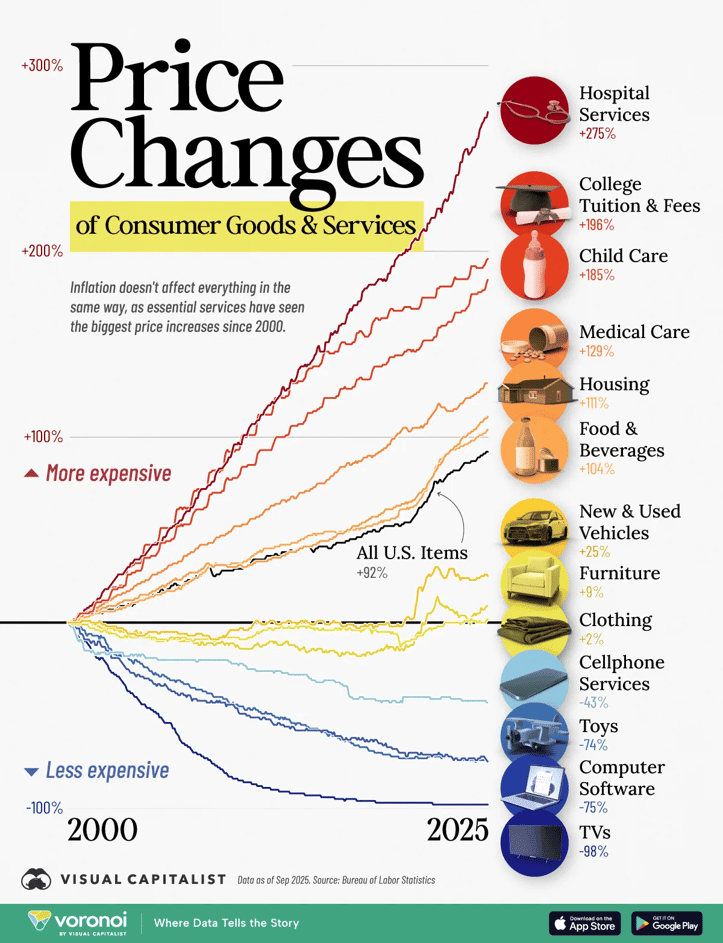
The pattern is impossible to ignore.
The things that have gotten dramatically cheaper are the things that operate closest to real market competition.
Consumer products like TVs, computer software, and toys.
Nobody has a federal agency setting software prices.
Nobody is running a giant subsidy program so Americans can afford flat screens.
Nobody needs a government permission slip to build a better toy.
Those markets are brutally competitive.
So companies have to get better. If they don’t, they get eaten.
Now look at the upper side of the chart.
Medical services, college tuition, housing, food.
The higher up the chart you go, the more government intervention you tend to find.
Healthcare, college, housing, and food are all loaded with subsidies, mandates, licensing rules, government money, political protection, or some combination of all of them.
So when people say that “capitalism is making everything expensive”...
They have it exactly backward.
The most market-driven goods are the ones where consumers keep getting more for less.
The most politicized sectors are where prices explode.
Healthcare Is the Obvious Example
A modern fitness tracker is basically a health-monitoring device.
It can track your heart rate and blood oxygen, monitor your sleep, and estimate recovery.
A few decades ago, that kind of personal health data would have sounded like science fiction.
Now companies are fighting to sell it to you for less than the cost of a decent pair of shoes.
That is what happens when health technology exists outside the official healthcare machine.
But the moment you step into the actual healthcare system, the pricing looks completely different.
Suddenly, everything gets buried under insurance, billing codes, hospital networks, government reimbursement, licensing rules, and regulatory fences.
Because now, the person using the service is often not the person directly paying for the service.
The person providing the service is often not competing on transparent prices or quality.
And the people writing the rules have enormous power to protect the incumbents already inside the system.
So prices go up.
The free market didn’t fail – but we failed to have free markets.
A company trying to sell me a fitness tracker has to make something I actually want at a price I’m willing to pay.
A hospital system operating inside a heavily regulated, insurance-driven, politically protected industry does not face the same kind of consumer pressure.
That is why you can buy advanced health-tracking technology for around $100…
While official healthcare keeps getting more expensive year after year.
Don’t Confuse Capitalism with Cronyism
A lot of people blame capitalism for problems created by government intervention.
That drives me crazy.
Capitalism is when a company has to serve customers to survive.
Cronyism is when a company can use political power to avoid real competition.
Those are completely different things.
In a free market, the producer has to serve the consumer.
In a politicized market, the producer can serve the regulator, the bureaucrat, the politician, or whoever controls access to the money.
That is when prices start to rise without the same pressure to improve.
Adam Smith put it simply:
“Consumption is the sole end and purpose of all production.”
Production exists for the consumer.
Not the lobbyist, the regulator, or the protected incumbent.
The customer.
And the more a market is forced to serve the customer, the better the results usually get.
That is why I love capitalism as a consumer.
And as a producer, it forces me to keep stepping up my game.
Because if I stop serving people well, someone else will come along and do it better.
And that is exactly how it should work.
Until next time,
Joe Brown
Heresy Financial
Letters From a Heretic
Don't miss out!
Get our free, no-spam, weekly digest. Unsubscribe anytime. Never miss out on crucial financial insights!


I really enjoyed this course. Joe has a special skill at teaching. He is very concise which I appreciated. The only thing I was an experienced investor at was real estate so I am a complete newbie to all the other assets he touches on in this course. I feel much more confident now about investing in the stock market, his explanation of options and hedging was really insightful as well.

I loved this course. It was knowledgable and gave me a new perspective on capital management. The portfolio you put together made so much sense to me, and it's kind of surprising that it's not more widespread. I really liked how you broke down mainstream portfolios and explained the pros and cons of each. It helped me get a better sense of the investment landscape and made me feel more confident