Dear Reader,
America’s debt crisis is accelerating.
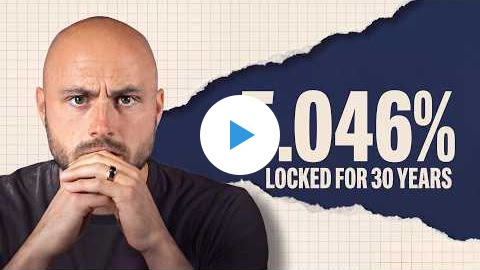
In the middle of May, the U.S. Treasury sold $25 billion worth of 30-year bonds at a yield of 5.046%.
That was the highest yield on a 30-year auction dating back to 2007.
I talked about this in my video here:
But just a week after that…
The Treasury sold a further $16 billion of 20-year bonds at a yield of 5.122%.
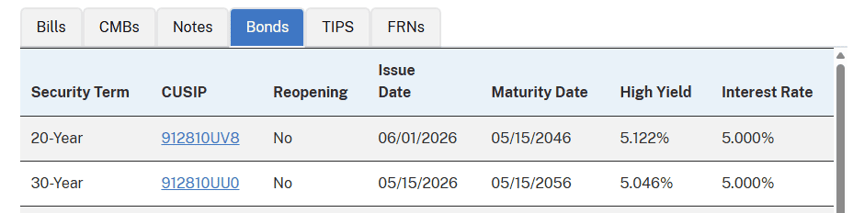
Normally, you would expect bonds with a shorter maturity to have a lower yield.
Instead, what we just saw was – right after a 30-year bond had to be sold at the highest yield in nearly two decades…
A shorter-dated 20-year bond had to be sold at an even higher yield.
In other words…
Demand for American Debt is Cracking…
Which is why the Treasury has to offer higher and higher yields to still attract buyers.
And we’re seeing this across the entire maturity spectrum.
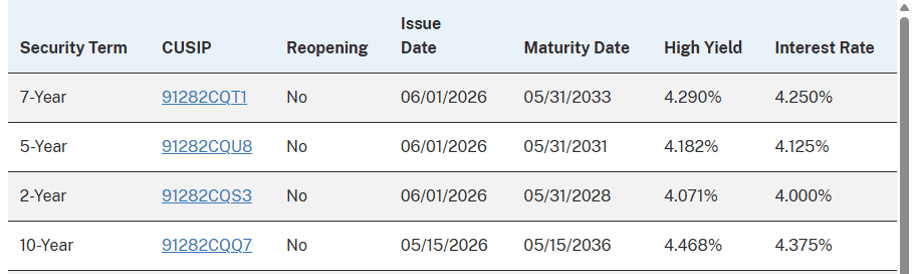
The latest 2-year auction closed at above 4%.
The latest 10-year auction almost touched 4.5%.
And given the situation we are in right now…
With over $39 trillion in debt and zero political will from either side to seriously get that number down…
It makes sense to assume that yields will only keep going up.
But if there’s anything I’ve learned after all these years…
It’s that the markets are far more counterintuitive than most people think.
So while I believe that Treasury yields will most likely keep going up for a while…
The most probable – yet counterintuitive – outcome is that:
At a Certain Point, “Too High” Yields Will Actually Lead to LOWER Yields
You see, the government doesn’t just borrow new money.
It also has to refinance old debt as it matures.
And because so much of the national debt is short-term, yesterday’s cheap debt keeps getting rolled into today’s expensive debt.
That means interest expense can keep rising even if the debt itself stopped growing tomorrow.
That’s the trap.
Interest on the national debt has already passed national defense spending.
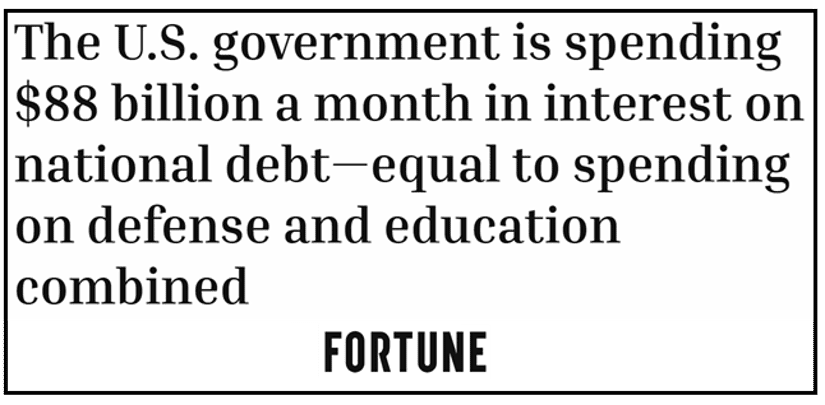
And interest does not actually build anything.
It is simply the bill for past deficits.
So when Treasury auctions start clearing above 5% on long-term debt, this is no longer just a bond market problem.
It becomes a budget problem… a political problem…
And eventually, a crisis-management problem.
Because Washington is not going to slash spending enough to fix this.
No wealth tax, income-tax hike, or “tax the billionaires” slogan is going to make a $39 trillion debt load disappear.
The numbers are too large.
So the real plan is much simpler:
Keep the machine running long enough for inflation and nominal growth to shrink the debt burden over time.
That’s what politicians mean when they talk about “growing” out of the debt.
But that plan only works if borrowing costs stay low enough.
If yields keep rising, the plan starts to fail.
Which means, at some point, Washington has every incentive to push back.
That is where the counterintuitive part comes in.
The higher yields go…
The more pressure builds for intervention.
And the more pressure builds for intervention…
The more likely it becomes that yields eventually get pushed lower.
Because the system cannot tolerate yields staying this high for too long.
There Are 3 Possible Interventions That Could Push Yields Down
One option is stablecoins.
To most people, stablecoins look like digital dollars.
But behind the scenes, regulated stablecoins need reserves to back them up…
And those reserves often flow into Treasury bills.
So if stablecoin usage expands, it could create another pipeline of demand for U.S. debt.
Another option is reinforcing global dollar usage through swap lines and dollar arrangements with foreign countries.
The more the world uses dollars, the more the world needs places to park dollars.
And at least for now, Treasuries are still the main parking lot for those dollars.
But the biggest lever may be bank deregulation.
Specifically, changes to something called the supplementary leverage ratio (SLR).
I know that sounds boring.
But this is probably the rabbit they try to pull out of the hat.
The supplementary leverage ratio limits how much banks can expand their balance sheets.
And because Treasuries count against those limits, banks can be restricted from loading up on government debt.
If regulators loosen that rule, banks suddenly have more room to buy Treasuries.
That is exactly what happened in 2020 when the SLR was temporarily relaxed.
Banks had more room to absorb Treasuries, and yields fell across the curve.
Now let me be clear…
All These Options are Band-Aids – Not Long-Term Fixes
That’s just how Washington operates nowadays – pure short-term thinking.
They’re not interested in fiscal discipline…
They’re interested in the easiest path that would allow them to keep borrowing and spending.
This has created an interesting setup.
On the surface, the conclusion seems obvious:
Yields are rising, so yields will keep rising.
After all, demand for U.S. debt is cracking.
Auction yields are climbing, and the debt burden is getting harder to finance.
But the second-order effect may be the opposite:
Yields rise so high that Washington is forced to push them lower.
This gap between “obvious” first-order perceptions and counterintuitive second-order effects is where some incredible opportunities can appear.
I’ve personally exploited these gaps to triple my trading account last year…
And pocket gains like 1,068% in 13 days…729% in under two months…and even 1,793% in just 11 days.
But with everything going on right now…
From the tech selloff and the war in Iran – to the accelerating debt crisis…
I’m seeing more and more of these gaps – and their related opportunities – crop up in the market.
That’s why next Thursday, June 18th at 7:00 PM Eastern…
I’ll be hosting a LIVE event where I’ll share more on how I systematically look for these gaps…
And use them to create asymmetric opportunities while the crowd is still waiting for confirmation.
(Attendance is free, but spots are limited)
Until next time,
Joe Brown
Heresy Financial
Letters From a Heretic
Don't miss out!
Get our free, no-spam, weekly digest. Unsubscribe anytime. Never miss out on crucial financial insights!


I really enjoyed this course. Joe has a special skill at teaching. He is very concise which I appreciated. The only thing I was an experienced investor at was real estate so I am a complete newbie to all the other assets he touches on in this course. I feel much more confident now about investing in the stock market, his explanation of options and hedging was really insightful as well.

I loved this course. It was knowledgable and gave me a new perspective on capital management. The portfolio you put together made so much sense to me, and it's kind of surprising that it's not more widespread. I really liked how you broke down mainstream portfolios and explained the pros and cons of each. It helped me get a better sense of the investment landscape and made me feel more confident