Dear Reader,
Three days from now, America turns 250.
And if you listen to most people on the internet…
You’d think we’re watching the final days of the American empire.
The debt is exploding.
The dollar is constantly being declared dead.
The country is politically divided in ways I don’t think most Americans fully understand.
So every week there’s another person explaining why America is finished.
I understand why people feel that way.
But I want to give you a much more uncomfortable possibility:
The American empire could be just beginning.
Not the republic…
The empire.
I know how that sounds.
This is not me saying this from some patriotic place where I’m waving a flag and pretending everything is great.
It’s not.
This is me trying to look at the situation from an objective, impartial, and unbiased view.
Because when I look at the political cycle we appear to be in…
And I look at the way capital is moving…
And I look at what has happened to other powerful countries in history…
I do not think we are necessarily at the end stage of the American empire.
In fact, I think we may be watching the beginning of the empire start to form.
The Cycle Polybius Saw 2,200 Years Ago
Polybius was a 2nd century B.C. Greek historian, so around 200 years before Jesus.
And he had a really fascinating idea about the cycle of government.
He described six forms of government – all of which were connected via a cycle called anacyclosis.
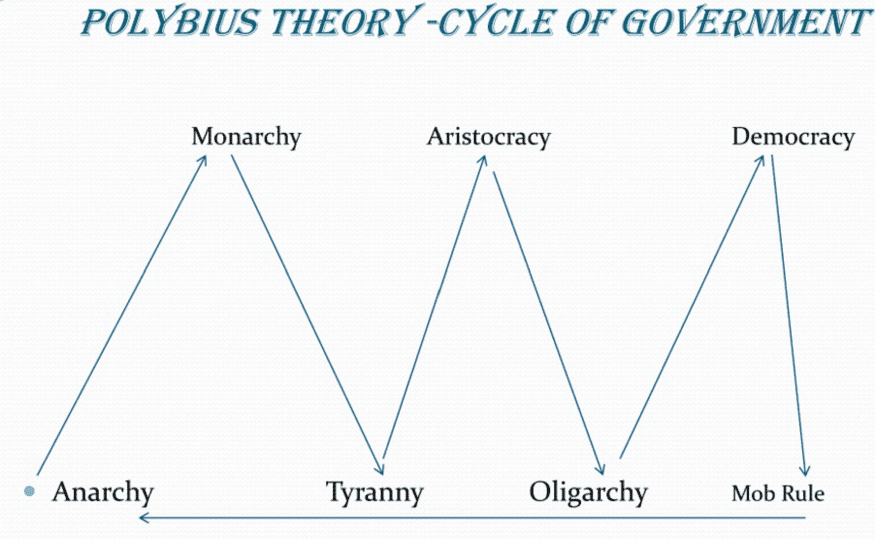
There were three “good” forms, with each eventually devolving into its “corrupted” form.
You start with monarchy – a good king.
Then monarchy degenerates into tyranny – a bad king/dictator.
The people overthrow the tyrant and install an aristocracy, where the wisest and most capable rule for the common good.
Eventually, the children of those aristocrats become complacent.
They start serving themselves.
That turns into oligarchy.
Angry citizens revolt again, and they establish democracy.
At first, democracy is ruled by the many under law, tradition, and mutual restraint.
But over time, democracy descends into mob rule.
That’s the tyranny of the majority.
It’s two wolves and a sheep voting on what to have for dinner.
Then out of the chaos and violence of mob rule, a strong man eventually takes control…
And the cycle resets back to monarchy.
It’s an interesting theory.
And obviously, when you see something like that and it sounds legit, the question is:
Where are we?
A Republic, If You Can Keep It
So let’s go back 250 years ago.
The most likely place to start is with the monarchy in England.
From the perspective of the colonies, that monarchy had degenerated into tyranny.
The people here were basically saying:
This isn’t serving us. This is tyranny – and we want out.
So they declared independence, fought a bloody war – and won.
In the Polybius framework, monarchy degenerated into tyranny…
The colonists overthrew that tyranny and installed something closer to aristocracy.
Now you might be thinking:
No, they didn’t – they installed democracy.
No, we weren’t. Not at first.
Maybe in name, but in practice, we were mostly a republic.
That’s why when Benjamin Franklin came out of the Constitutional Convention and somebody asked what kind of government they had given us, he said:
“A republic, if you can keep it.”
And that’s exactly what it was.
You had representatives.
You had checks and balances.
You had a system designed to filter popular passions through institutions.
You had the wisest and most capable people drafting the Articles of Confederation and then the Constitution.
Even if you look at who could vote early on, it was expressly not universal democracy.
It was mostly white male landowners.
In other words, the aristocracy.
So far, Polybius, writing 2,200 years ago, basically nailed this part of the cycle.
But from there, the cycle gets a bit more complicated.
America did not have one clean revolution where the aristocracy fell and a totally new structure appeared overnight.
The Constitution stayed. The official form remained.
But the practice and implementation of the system changed over a very long period of time.
The aristocratic republic gradually moved toward something more oligarchic.
You see the rise of banking power.
The rise of industrial power.
The establishment of the Federal Reserve.
The concentration of political and financial power in institutions that were far removed from the average citizen.
Then, over a long period you also see the move toward mass democracy.
Slavery was abolished. Women got the right to vote. Black Americans gained full voting rights.
The voting age eventually dropped to 18.
Now, to be clear, I’m not saying those were bad things.
Slavery was evil. Women deserved the vote. Black Americans deserved full citizenship.
The point here is not to argue against every expansion of voting rights.
The point is that, in practice, America moved away from the filtered republic of the founding era and toward mass democracy.
That transition took a long time.
But through the Polybius lens, it looks like America moved from aristocracy…to oligarchy…to democracy.
And now, I think that over the last 50 years…
American Democracy Has Descended Into Mob Rule
Judge and historian Alexander Fraser Tytler famously said that:
“A democracy cannot exist as a permanent form of government. It can only exist until the voters discover that they can vote themselves largesse from the public treasury. From that moment on, the majority always votes for the candidates promising the most benefits from the public treasury.”
And I think that’s the phase of democracy we’re in right now.
We are in mob rule, where 51% realizes it can vote to take from the other 49%.
Now, it doesn’t always look that clean.
It’s not one constant 51% against the same 49%.
It’s factions.
It’s interest groups.
It’s political coalitions.
It’s corporations lobbying for subsidies.
It’s voters demanding benefits somebody else has to pay for.
It’s politicians promising more from the public treasury because that is how elections get won.
Both parties do it.
They just do it for different constituencies.
And once that becomes the game, fiscal restraint becomes almost impossible.
Everybody wants a benefit, but nobody wants to pay the full cost.
So the debt grows, the government expands, and the political fights get uglier.
Eventually, people start losing faith in the whole class of leaders running the system.
That is where the next phase begins.
Everybody Wants a Strongman
Out of the chaos and violence of mob rule, Polybius says a strong man eventually takes control, resetting the cycle back to monarchy.
I don’t know whether this is Trump.
I don’t know whether this is somebody else who comes after him.
But it seems like we are headed that way.
There is so much dissatisfaction right now with the political class.
Both sides want somebody who will take control to serve their needs.
People on the left and right think they want totally different things.
But if you talk to them long enough, they express the same core desire.
Someone who can go in, make decisions, and actually “get things done”.
And of course, everybody imagines the strongman will be their strongman.
That’s the whole seduction.
If we just got the right person in that position, then the power would be used for good.
Now, is a good monarch impossible?
No. It is not impossible.
People point to Lee Kuan Yew in Singapore for a reason. He once said that:
“I do not believe that democracy necessarily leads to development. I believe that what a country needs to develop is discipline more than democracy.”
Singapore’s rise to become one of the most successful city-states in the world under his (near dictatorial) leadership makes that argument tempting.
But that’s also what makes it dangerous.
It makes people think the problem is just finding the right man.
But while having a good monarch is not impossible, it’s very very unlikely.
It’s not because, as the old saying goes – that “power corrupts and absolute power corrupts absolutely.”
I think it’s the other way around…
Power attracts the already corrupt – and absolute power attracts the already absolutely corrupt.
The people who should be in that position usually don’t want it.
The people who want it, 99 times out of 100, want it for the wrong reasons.
So you risk skipping from “good” monarchy straight into tyranny.
Still, whether you like it or not, the pressure toward concentrated executive power is clearly building.
And that means…
The American Empire Could Be Just Beginning
This is where I think people may be getting America wrong.
When people talk about the American empire, they usually talk as if the empire is already over.
The rest of the world is supposedly done with us.
But I think it’s very possible that it is just beginning.
When you look at Rome, the transition from republic to empire was not the end of Rome’s power.
It was the beginning of a new phase.
Rome existed as a republic for centuries.
Then it flipped into an empire under Augustus.
Even after that transition, Rome did not instantly disappear.
The republic ended, but the empire grew.
So if we are making the Rome comparison, America may not be Rome at the collapse.
America may be closer to Rome at the moment the republic gives way to empire.
Again, I’m not saying that as some sort of moral endorsement (you know how I feel about government in general).
I’m saying it looks like the United States is switching and flipping into empire mode.
And regardless of how you feel about the morality of that…
Regardless of how you feel about whether that should or should not be happening…
It looks like it may indeed be happening.
So What Does That Mean for Your Investments and Your Money?
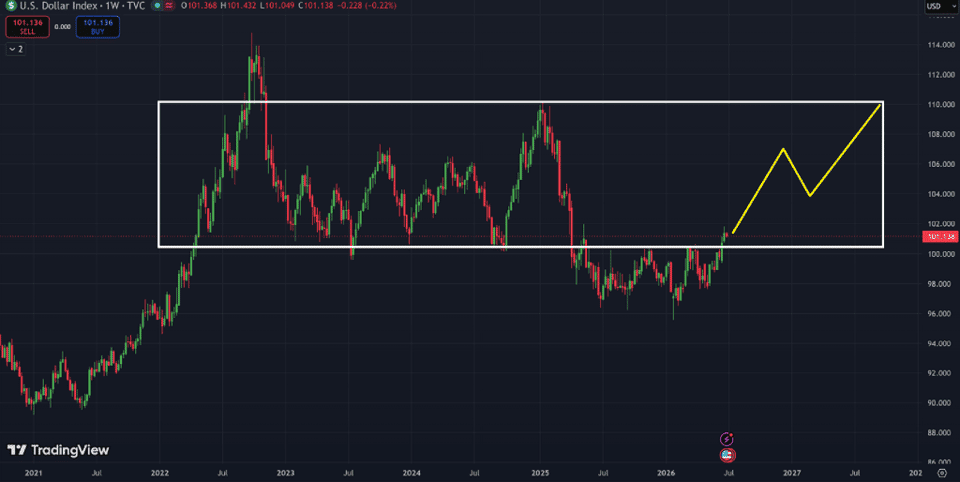
If this shift is indeed ongoing, it means the dollar may have a lot longer to live than the dollar bears think.
Most people were predicting the death of the dollar.
But we’re already seeing the dollar start to rise versus other currencies – and it looks like it could keep strengthening.
We’re also starting to see record amounts of foreign investment flood into the United States, at a scale we have literally never seen before.
Check out this chart.

This is U.S. net capital inflows going back to 1980.
And we have never seen this level of foreign investment coming into the United States.
Again, this is not me saying America is morally good because money is flowing here.
I’m just stating an objective fact about capital flows.
And since capital usually flows toward power, liquidity, depth, security, and opportunity…
The fact that global capital is still flowing into the United States at an incredible rate could mean that betting against America at this point may be a very dangerous trade.
I’m not saying that from a patriotic place.
I’m saying it as an investor trying to protect and grow wealth.
If America really is moving into empire mode, then it’s going to be hard to make a lot of money by betting against the beginning of a major empire.
The moral question is one thing.
The investment question is another.
You may not like the direction America is going.
I certainly don’t like a lot of it.
But if this is where the system is moving, then as investors we have to deal with reality – not the version of reality we wish existed.
So, today’s heretical take is this:
The American republic may be ending.
But the American empire could be just beginning.
And if that is true, it is probably something you want to place your money on – not against.
Until next time,
Joe Brown
Heresy Financial
Letters From a Heretic
Don't miss out!
Get our free, no-spam, weekly digest. Unsubscribe anytime. Never miss out on crucial financial insights!


I really enjoyed this course. Joe has a special skill at teaching. He is very concise which I appreciated. The only thing I was an experienced investor at was real estate so I am a complete newbie to all the other assets he touches on in this course. I feel much more confident now about investing in the stock market, his explanation of options and hedging was really insightful as well.

I loved this course. It was knowledgable and gave me a new perspective on capital management. The portfolio you put together made so much sense to me, and it's kind of surprising that it's not more widespread. I really liked how you broke down mainstream portfolios and explained the pros and cons of each. It helped me get a better sense of the investment landscape and made me feel more confident