Dear Reader,
I don’t care about global warming.
Not because I don’t believe it’s true…
But because I believe it’s actually GOOD for us.
How’s that for a heresy?
But before I explain why, I want you to take a look at this picture from NASA satellite imagery.
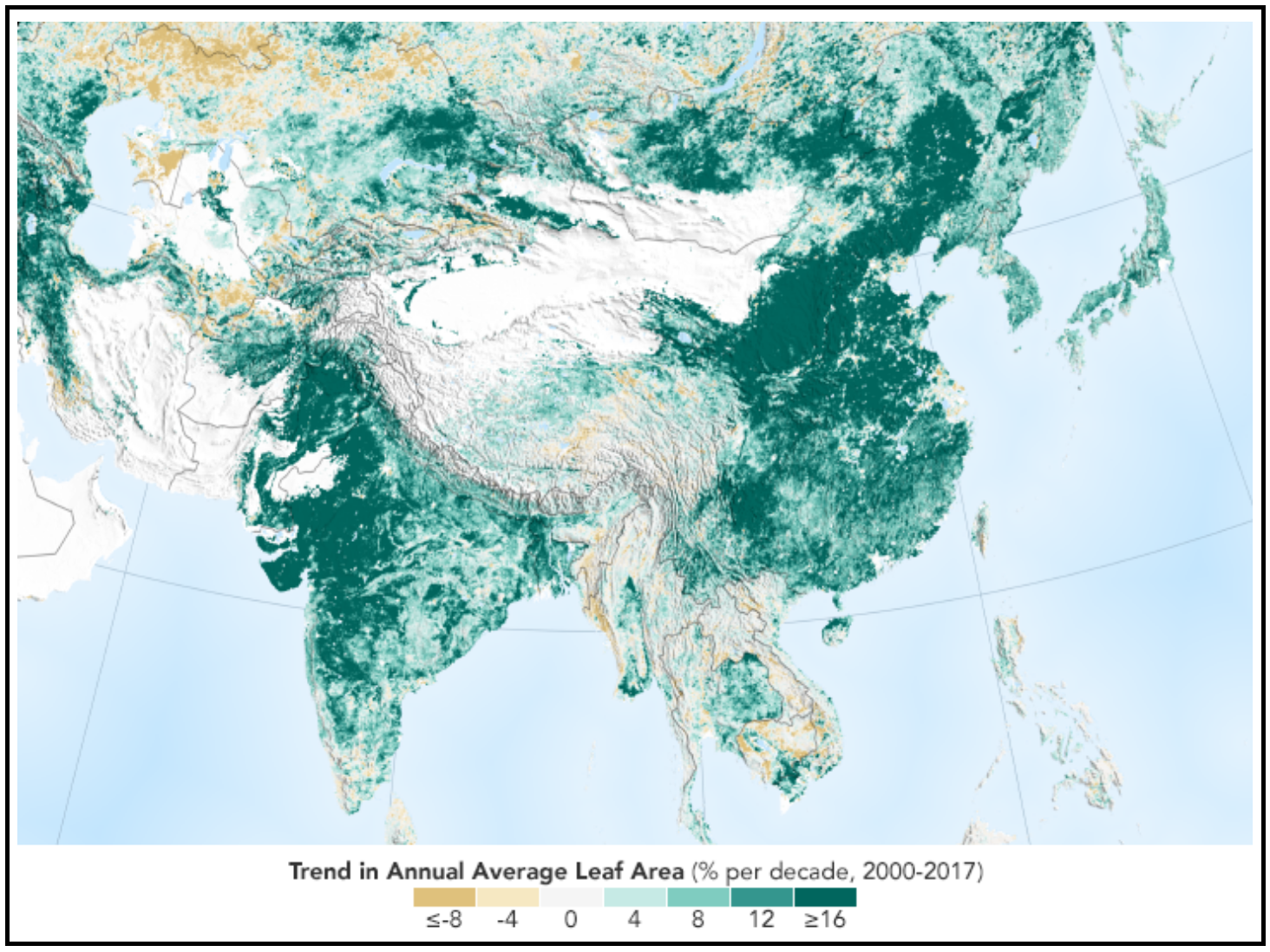
The green areas show the increase in average leaf area per decade.
Essentially, the satellites show that the earth has increased its green leaf area by 550 million hectares over the past two decades…
Which is the equivalent of the entire Amazon rain forest.
Imagine that, despite all the talk about deforestation in the Amazon, we’ve added a new Amazon rain forest to the planet.
And the chief “culprit”? Carbon dioxide.

That’s right, CO2 – the primary “greenhouse gas”...
Public enemy #1 of the climate technocrats.
And what’s really surprising is where most of the greening is coming from.
China and India – two of the biggest greenhouse gas emitters in the world.

Even without even looking at the data, this finding is rather intuitive.
CO2 is literally plant food.
And you grow plants in a greenhouse. So it should be natural to expect that a greenhouse gas would lead to greening.
That’s why it’s not just limited to China or India either.
All over the world – from Australia to Africa – once arid drylands are becoming greener.
Some scientists used to worry that climate change and agriculture would lead to “desertification”...
Something that U.N. officials have called the “the greatest environmental challenge of our time”.
And yet, the exact opposite has happened. These brown drylands are turning green.
But that’s not the only benefit of increased CO2.
CO2 = Food and Progress
The data shows that between 1961 and 2017, CO2 fertilization increased rice and wheat yields by around 7%. Even corn saw gains.
In short, more CO2 has led to more food – which leads to fewer hungry people.
And there’s the inconvenient fact that CO2 emissions are correlated with prosperity.
Because more emissions don’t just mean more heat – they mean more steel, more food, more roads, more energy, more growth.
Historically, the more energy a country uses, the faster it grows.
From the Industrial Revolution to modern China and India, GDP and CO2 emissions have moved hand in hand.
That relationship has loosened somewhat in recent years, especially in more advanced economies.
But for most of history – and in most developing economies of today – this relationship has held true.
It’s not because these countries hate the environment.
It’s because they’re building homes, factories, power plants, fertilizer systems, highways, steel mills – the backbone of modern civilization.
And fossil fuels are still the cheapest, most reliable way to power all of it. And when you burn fuel, you emit CO2.
This means CO2 isn’t just a greenhouse gas. It’s a byproduct of civilizational progress.
If you want a deeper dive into the philosophy and facts behind this argument, I highly recommend reading Alex Epstein’s Fossil Future: Why Global Human Flourishing Requires More Oil, Coal, and Natural Gas—Not Less.
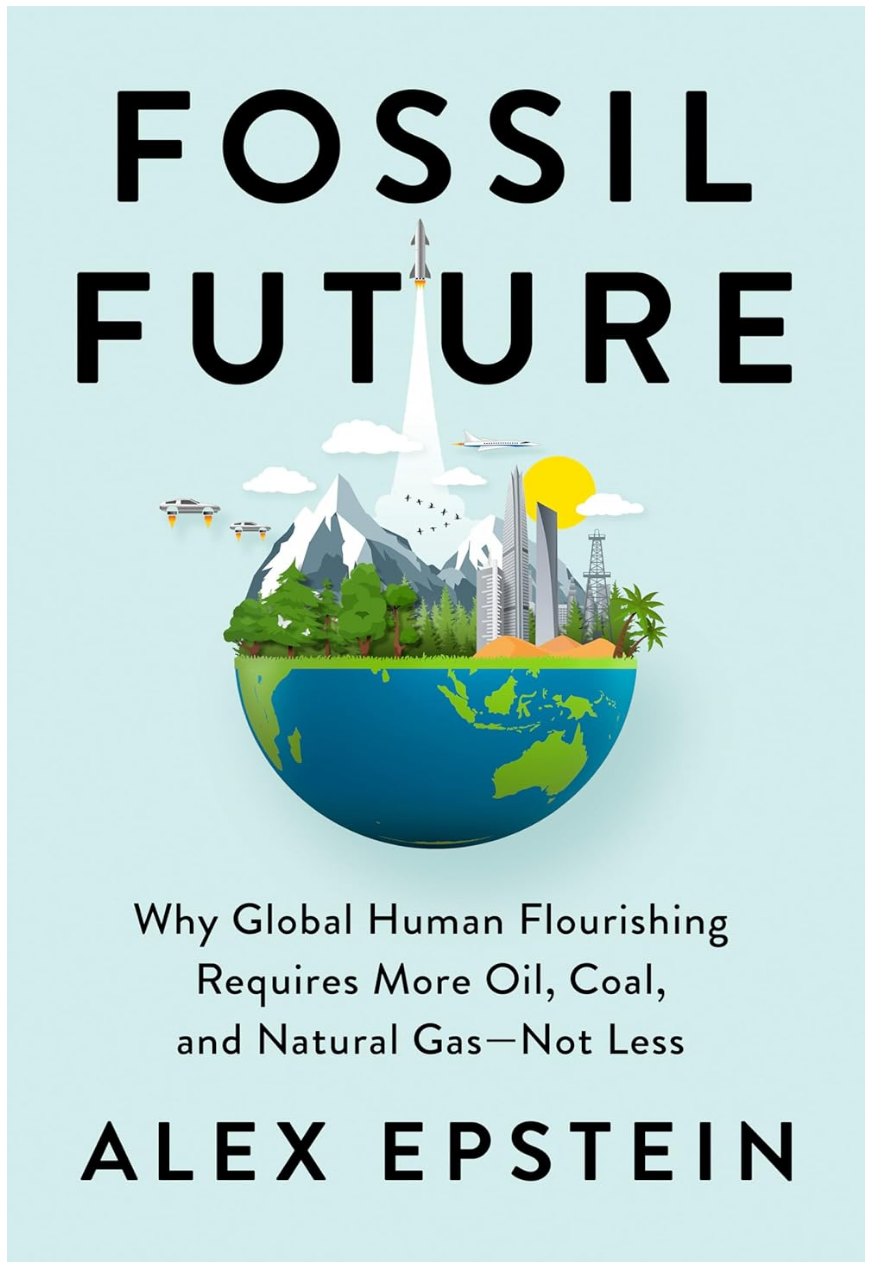
It’s one of the most important books I’ve read on energy, climate, and the real moral case for progress.
But of course, this side of the story rarely gets told.
Because it doesn’t fit the narrative. You see…
The “Carbon Panic” is More About Control Than Science
The thing about carbon emissions is that they emerge naturally as a consequence of a growing economy.
But that’s not how central planners think.
They don’t want an organic feedback loop. They want command and control.
So they frame CO2 emissions as categorically dangerous – a “pollutant” that must be purged, no matter the cost.
And they use that to justify top-down coordination of the entire economy.
They cap emissions, regulate industries, push ESG mandates, redirect capital, and create global bureaucracies that make energy policy without a single vote cast.
French President Jacques Chirac once called the Kyoto Protocol “the first step toward global governance”.

And we’re seeing many of its effects play out today.
Take a look at how development banks now block fossil fuel funding in Africa…
Or how the World Bank has stopped financing gas projects in low-income nations…
Or how Global ESG frameworks are starving carbon-based infrastructure of capital – especially in the very nations that need it most.
They frame it as sustainability.
But the only thing they’re really interested in sustaining – is their own power.
-Joe Brown
Heresy Financial
Letters From a Heretic
P.S. I believe that investors are increasingly realizing we need these scarce fuels to keep powering our modern economy. And that’s helping drive the mega commodity boom we’re in right now.
That’s why, last Sunday, I went live to share my strategy for playing this boom – a strategy that's allowed me to bank realized gains of 620%, 282%, and even as high as 929%.

I think this boom will be the biggest we’ve seen in 50 years. So I urge you to click here to watch the replay before I take it down at midnight ET tonight.
Don't miss out!
Get our free, no-spam, weekly digest. Unsubscribe anytime. Never miss out on crucial financial insights!


I really enjoyed this course. Joe has a special skill at teaching. He is very concise which I appreciated. The only thing I was an experienced investor at was real estate so I am a complete newbie to all the other assets he touches on in this course. I feel much more confident now about investing in the stock market, his explanation of options and hedging was really insightful as well.

I loved this course. It was knowledgable and gave me a new perspective on capital management. The portfolio you put together made so much sense to me, and it's kind of surprising that it's not more widespread. I really liked how you broke down mainstream portfolios and explained the pros and cons of each. It helped me get a better sense of the investment landscape and made me feel more confident